

Many professional and trade association leaders use the terms association management software (AMS) and customer relationship management (CRM) interchangeably. However, this highlights a common misconception that clouds the benefits that an AMS built on top of a CRM platform can provide.
To equip your association for long-term success, we’ll distinguish between AMS and CRM platforms. We’ll cover:
- Quick Comparison: AMS vs. CRM
- What is AMS Software?
- What is CRM Software?
- Understanding the Difference Between AMS and CRM Software
- Do You Need Both an AMS and a CRM?
- AMS and CRM: Creating a Complete Association Toolkit
- Choose the Protech Approach
Read on to learn more about how the right association software systems can strengthen your organization’s operations, relationships, and long-term health.
Key Takeaways
- An AMS is built specifically to handle day-to-day association operations, such as dues processing and event registration. A CRM is a broader tool used to track interactions, analyze member behavior, and drive revenue growth.
- Relying on just an AMS or a CRM can leave your association with blind spots. Combining their capabilities with a CRM-based AMS is key.
- Not all CRM-based AMSs are created equal—make sure you understand which red flags to look for and questions to ask before making a decision.
Key Takeaways
- An AMS is built specifically to handle day-to-day association operations, such as dues processing and event registration. A CRM is a broader tool used to track interactions, analyze member behavior, and drive revenue growth.
- Relying on just an AMS or a CRM can leave your association with blind spots. Combining their capabilities with a CRM-based AMS is key.
- Not all CRM-based AMSs are created equal—make sure you understand which red flags to look for and questions to ask before making a decision.
Quick Comparison: AMS vs. CRM
What are the fundamental differences between AMS and CRM platforms?
| Association Management Systems (AMS) | Customer Relationship Management Systems (CRM) |
|---|---|
| Overall PurposeManaging the specific, day-to-day needs of member-based organizations like memberships, event planning, and engagement | Overall PurposeManaging relationships with contacts (members, sponsors, etc.) to track interactions and drive revenue |
Core Functions
|
Core Functions
|
| Built ForMembership organizations like trade and professional associations | Built ForAny organization in diverse industries, often designed with businesses in mind |
| Used ByAssociation leaders, membership managers, event planners, finance teams, and others | Used ByOrganizational leaders, marketers, development professionals, and others |
Example Tasks
|
Example Tasks
|
The key differences between AMS and CRM platforms include:
- AMS platforms
- Designed specifically for membership organizations to facilitate member interactions, foster engagement, and process transactions. An AMS allows you to learn more about your performance and bring your strategies to life.
- CRM platforms
-
- Designed for any organization to store large sets of contact data, track engagement and touchpoints, analyze contact behavior, and automate tasks using the organized contact data. A CRM gives you foundational insights into your organization’s operations and relationships.
With these big-picture differences in mind, let’s take a closer look at how each platform works.
What is AMS Software?
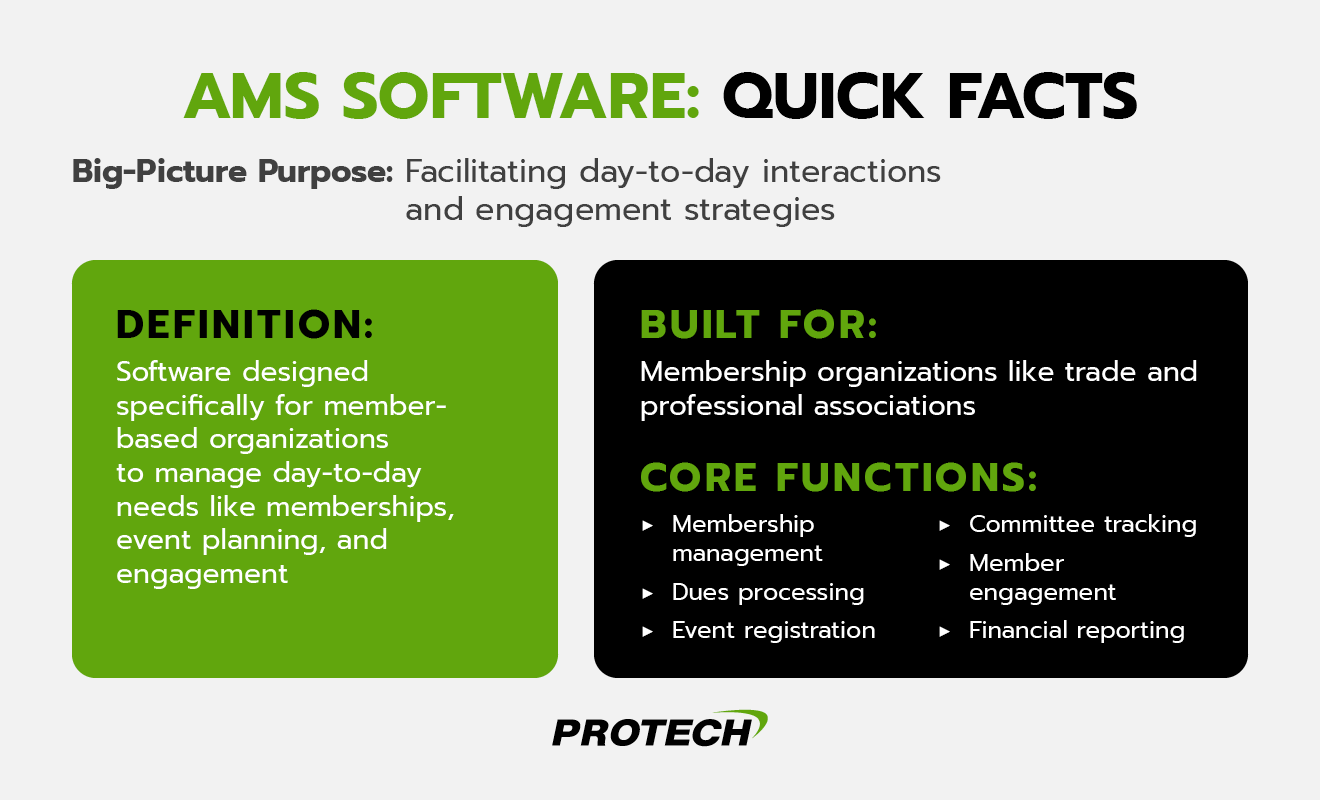
Association management software (AMS) refers to the technologies, business tools, and services that an association utilizes to manage and leverage data for decision-making.
Depending on your AMS’s functionalities, it may also facilitate most day-to-day interactions with members. For example, Capterra describes how AMS systems can help with “generating mail lists, organizing events, tracking the interests of members and donors, and sending out mass emails to your lists.”
With an AMS, your association can:
- Streamline workflows
- Automate daily administrative tasks for your staff
- Deeply engage with members through community forums
- Maintain website development
- Organize e-commerce history of your members (including subscriptions)
- Organize committee and chapter management tasks
- Create exhibit, sponsorship, and advertising services
- Integrate learning management systems (LMS) for education and professional development for your members
- Develop fundraising channels and organize volunteer management services
- Securely accept a variety of payment methods, including international, ACH, and digital wallet payments
- Integrate with financial management systems for seamless accounting functions
- Create surveys
- Support job boards
- Integrate with social media platforms
- Create interactive events for your members
- Develop mobile apps
Think of AMS software as the member-facing system that not only helps you strategize your different campaigns and events but also provides an interface for interacting with members. If you’re interested in learning more about association management software, contact us for a consultation.

What is CRM Software?
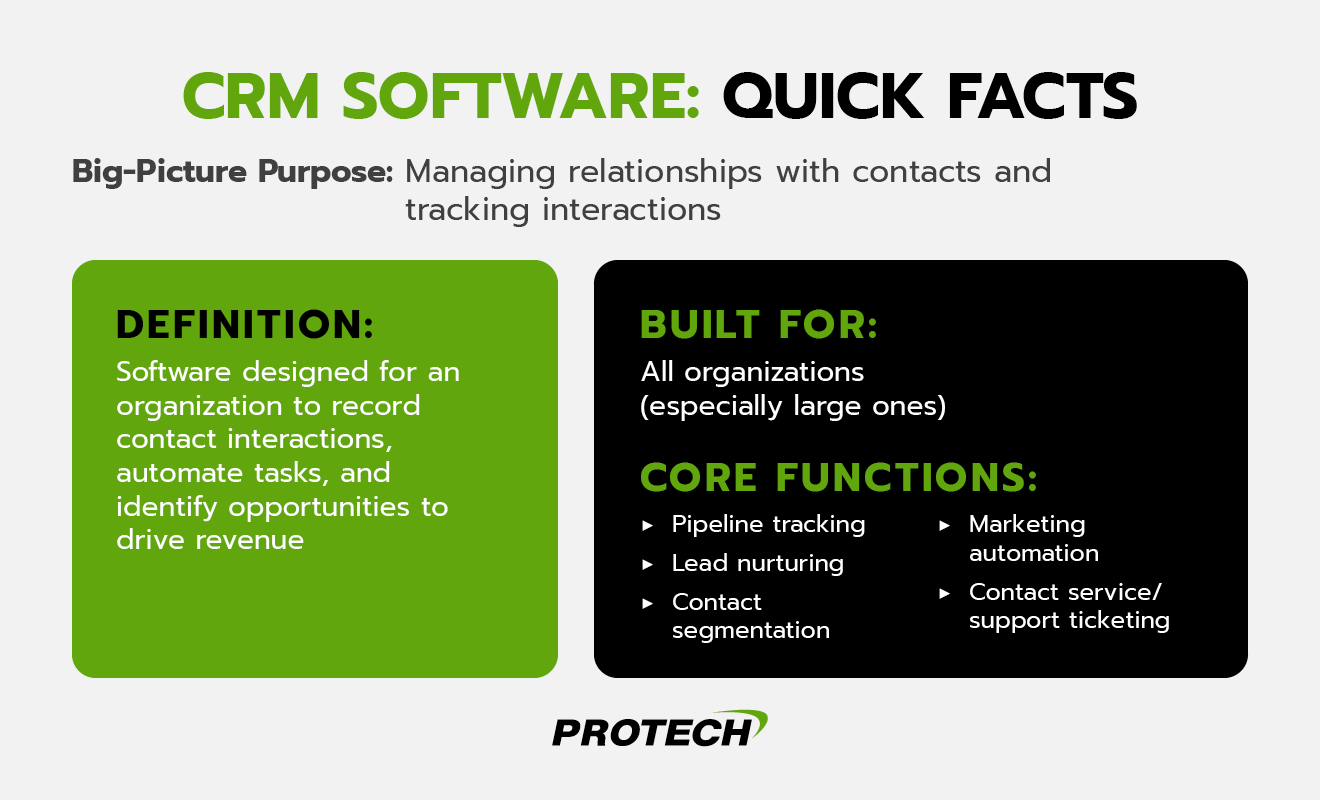
Customer relationship management (CRM) software refers to the tools and strategies organizations use to store interaction data and strengthen relationships with their target customers, members, or supporters. For example, CRM systems can store your members’ engagement histories and data, which can be used in targeted marketing campaigns.
To make the most of CRM software, you must truly understand both the technology and the philosophy behind it. This promotes organization-wide adoption, allows you to customize the software to fit your needs, and enables you to fit it into your broader member engagement and acquisition strategies.
Any CRM, especially those at the enterprise level, can be complicated and needs dedicated attention and support to generate value.
Understanding the Difference Between AMS and CRM
To recap, both an AMS and CRM collect and store data about your association’s members.
However, an AMS is a specialized tool designed to serve your members, assist staff in day-to-day operations, and address association-specific needs with precision. A CRM, on the other hand, is a more versatile tool for closely tracking interactions with prospects and current members so staff can determine the best ways to engage them.
A well-managed CRM fuels strategic efficiency and long-term growth, for example, by revealing new strategic insights (which you can then address using the features of your AMS).
Why Does It Matter?
Your association will need some of the core functionalities included in a CRM, so you must know what they are and how they differ from standard AMS features. This way, you won’t fall into the trap of implementing an AMS, thinking it will come with tools that are typically associated with CRMs, as this is not necessarily guaranteed. On the other hand, a CRM won’t provide those core association and membership management tools you need for daily operations (without costly workarounds).
If you don’t have CRM functionality, it can be easy to stagnate because you don’t have the insights needed to enhance your organization. However, when you have the close data tracking and strategic insights that CRMs can deliver, you can develop data-driven approaches that help you grow.
Do You Need Both an AMS and a CRM?
Yes, you do need both an AMS and a CRM to deliver personalized member experiences and sustain long-term, strategic growth.
Investing in an AMS platform provides the foundational member-facing tools your staff and membership expect—think member dashboards, member community functionality, and other tools tailor-made to promote the online member experience. But relying solely on an AMS makes it difficult to track long-term engagement, analyze member behavior, and manage complex sponsorship pipelines.
Using both an AMS and a CRM offers opportunities to refine your engagement, retention, and acquisition techniques, which lead to long-term revenue growth and increased efficiency. Just take a look at the following functions made possible by a member-oriented CRM:
- Scale operations as your association grows
- Automate customer-facing business processes
- Optimize member engagement and customer service
- Implement business intelligence and analytics tools
- Provide revenue projections for executives
- Enterprise Resource Planning (ERP)
- Score prospective members
- Implement geolocation technology
- Human resource management
- Implement marketing automation tools
- Implement artificial intelligence (AI), machine learning (ML), and robotic process automation (RPA) tools
- Access data through mobile devices
- Social networking integrations
- Field services automation
If your association considers itself an enterprise organization, you need a fully functioning CRM to handle these administrative tasks.
AMS and CRM: Creating a Complete Association Toolkit
For associations ready to upgrade their tech stacks on a large scale, the best choice is a purpose-built CRM-based AMS (an AMS solution that includes foundational CRM functionalities). These combined solutions will give you access to the right tools to handle core tasks, as well as the add-on components and integrations with third-party applications you need.
In other words, these solutions allow your team to easily fill any gaps in your current technology stack and intelligently tackle every facet of your association’s operations.
Red Flags When Evaluating AMS & CRM Vendors
Keep in mind that some software might claim to offer both AMS and CRM capabilities without actually having the functionality to back up those statements. To ensure the software you choose is truly an all-in-one solution, keep an eye out for these red flags:
- Mentions of a “sync” or “bridge.” If the vendor talks about data syncing between the CRM and the member portal, the solution may actually be two separate systems connected via an integration. A true CRM-based AMS should only use one database.
- Custom development is required for basic association tasks. If tracking CEU credits or managing dues requires custom coding or clunky workarounds, you are likely looking at a standard CRM that is not designed for associations.
- The CRM only tracks basic information. Part of what a CRM does is track contact information and email history; however, a capable CRM-based AMS should go beyond these basic functions. A robust solution should offer more advanced features as well, such as tracking complex corporate memberships or engagement scoring.
- You will have to export to Excel. If you are told you need a third-party business intelligence tool or manual spreadsheet exports to build reports, the solution doesn’t have the analytics tools you need to gain actionable insights.
How to Choose A CRM-Based AMS
As you research your options, prioritize vendors that:
- Specifically discuss and walk through their CRM features: You want real details and examples, not vague descriptions.
- Include CRM features in their pricing structures in a straightforward way: Upgrades and add-ons can become costly fast.
- Offer demos of their software: Get a firsthand look at both the AMS and CRM features your association will rely on.
When meeting with a potential vendor, consider asking the following questions to ensure the solution actually offers the full functionality you need:
- How does your system handle complex membership structures, like tiered dues or corporate memberships?
- What kind of reporting and analytics tools are built into the system?
- Does the software provide a complete view of a member’s engagement, including event attendance, purchases, communications, and more?
- How does the platform support sales efforts for things like sponsorships or advertising?
- How does the system handle event registration and management for both members and non-members?
- Can we automate marketing and communication workflows based on member behavior or renewal cycles?
- What does the typical implementation timeline look like, and how much custom development (if any) is required?
- Can your platform easily integrate with our other systems (e.g., your accounting software or learning management system)?
Be sure to discuss the distinctions between AMS and CRM software with staff so that your entire purchasing team understands that CRM features boost long-term growth and bolster the benefits of your AMS. Internal resistance can be a major technology challenge in associations, so securing buy-in will pay dividends down the road.
Choose the Protech Approach
The Protech team understands the individual importance of these systems and how they both come together to simplify the often difficult and complicated task of association management. That’s exactly why we’ve created an AMS system built around CRM principles, strategies, and tools.
With our CRM-based AMS, you no longer have to compare these two systems and weigh their strengths and weaknesses. Instead, Protech offers a robust suite of integrated tools, including event, professional development, and membership management, so your team can comprehensively understand your association in a single centralized system.
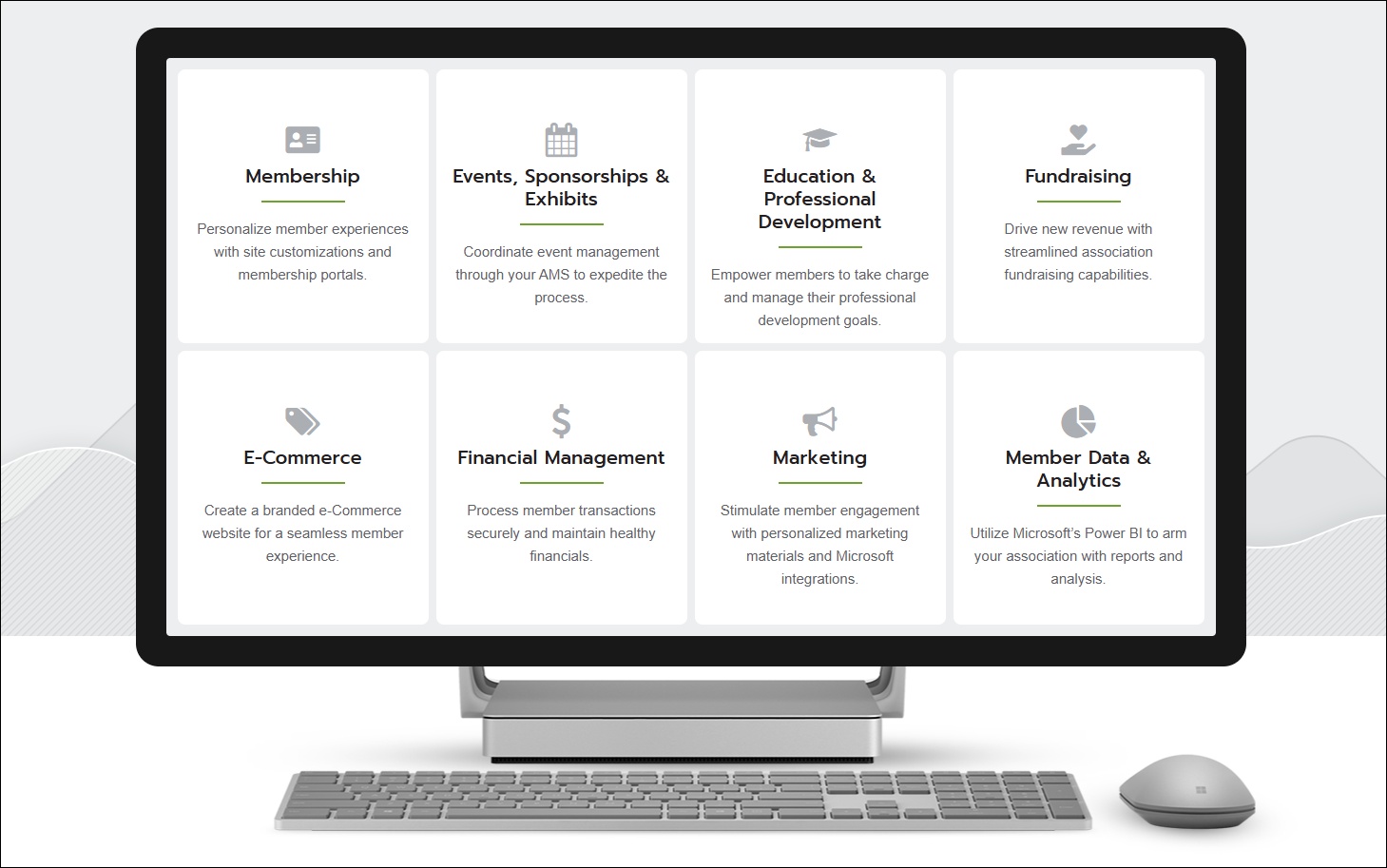
Built on Microsoft’s most powerful technology, Protech’s robust AMS is built to help any association at any level of development reach its fullest potential.
Want to learn more about Protech’s advanced CRM-based AMS? Request a demo of our simple, flexible, and robust association management solution.

Additional Resources
As you begin your technology search, you’ll likely run into more questions—keep learning! By gathering all the information you need to make informed decisions for your association, you’ll set your team up for long-term success.
If you’d like to learn more, we’ve gathered a few additional sources that can help:
- One-Stop Buyer’s Guide to Membership Management Software
- Association Software 101: How to Find the Best AMS Platform
- How to Set Up Your Membership Directory + Key Elements